Resin Transfer Molding (RTM) 370 Resin for High-Temperature Applications
Materials and Coatings
Resin Transfer Molding (RTM) 370 Resin for High-Temperature Applications (LEW-TOPS-115)
A solvent-free, low-melt process for creating a high-performance resin with zero emissions
Overview
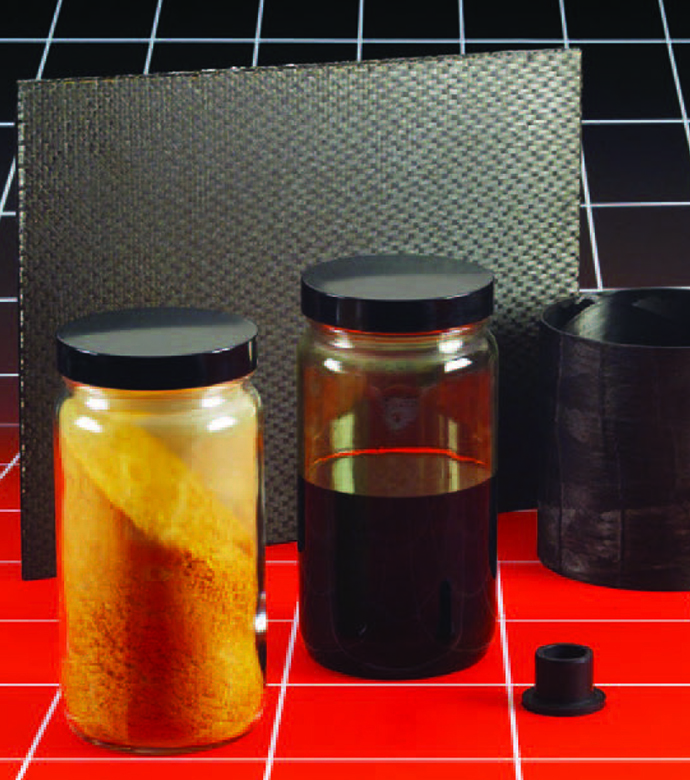
Innovators at NASA's Glenn Research Center have developed a Resin Transfer Molding (RTM) imide resin known as RTM370 that is generated using a revolutionary, solvent-free process. Its many desirable properties earned it a prestigious R&D 100 Award in 2017. RTM370 has a high glass transition temperature (Tg = 370°C), low-melt viscosity (20 to 30 poise), and long shelf life (up to 2 hours). It can perform at temperatures exceeding 300°C. It melts at 260 to 280°C and can be cured at 340 to 370°C without releasing any harmful or volatile compounds. It is suitable for composite fabrication by injection molding, RTM, resin film infusion (RFI), or vacuum-assisted resin transfer molding (VARTM). Furthermore, carbon fiber filled RTM370 is adaptable to additive manufacturing and can be printed into composite parts by laser sintering - a major breakthrough in high-temperature composite fabrication. These cutting-edge carbon fiber composites can replace any metallic part, providing high-quality, lightweight materials to a variety of industries at low-cost.
The Technology
RTM370 imide resin was developed to address the limitations of conventional imide resins, which are generated from commercially available symmetrical biphenyl dianhydride and oxydianiline (ODA). These resins form symmetrical dianhydride or diamine compounds that result in a substance with much higher viscosity than is viable for RTM, RFI, and VARTM. RTM370 harnesses the unique properties of asymmetric biphenyl dianhydride (a-BPDA) used in combination with a kinked ODA and a 4-(Phenylethynyl) phthalic anhydride endcap to form a mixture that can be melted without the use of solvents, and achieve the desired low-melt viscosity. RTM370 displays a high softening temperature (Tg = 370°C) and can be melted at 260-280°C. It can then be injected into fiber preforms under pressure (200 psi) or through a vacuum (VARTM) to form composites with excellent toughness. The resin can also be made into powder prepregs by melting the resin powders so that they fuse onto fibers. Recently, carbon fiber filled RTM370 imide resins have been fabricated into composites by laser sintering. This exciting advancement in additive manufacturing represents a new frontier for high-temperature composites.
Not only are RTM370 composites lightweight, durable, and impact-resistant, they also possess outstanding abrasion resistance and significant thermo-oxidative stability (as demonstrated in long-term isothermal aging at 288°C for 1,000 hours). In summary, this groundbreaking approach yields a vastly superior resin for fabricating high-quality composites with improved performance, durability, and adaptability. RTM370's unique, solvent-free melt process is simpler, more environmentally friendly, and more cost-effective than competing systems, lending it broad appeal for a variety of Earth-based applications.

Benefits
- High-temperature capability: Retains mechanical properties at extremely high temperatures (up to 315°C)
- Long pot-life: Maintains suitable viscosity for RTM and RFI (20 to 30 poise) for 1 to 2 hours
- Lightweight: Components made from RTM370 are 30 percent lighter than metallic parts
- Clean and green: This solvent-free production process does not produce any harmful, volatile compounds
- Excellent impact-resistance and char yield: RTM370 composites demonstrate high impact resistance and outstanding abrasion resistance at ambient and high temperatures
Applications
- Mechanical systems
- Oil and gas
- Construction
- Electronics
- Aerospace
- Automotive
- Marine
- Commercial space
Similar Results

New Resin Systems for Thermal Protection Materials
This method produces a low density ablator similar to Phenolic Impregnated Carbon Ablator (PICA) using a cyanate ester and phthalonitrile resin system, rather than the heritage phenolic resin. Cyanate ester resin systems can be cured in a carbon matrix and generate high surface area structure within the carbon fibers. This helps to reduce the thermal conductivity of the material which is one of the key requirements of thermal protection system (TPS) materials. The material has densities ranging from 0.2 to .35 grams per cubic centimeter. NASA has successfully processed the cyanate ester and phthalonitrile resins with a morphology similar to that of the phenolic phase in PICA, but with more advanced properties such as high char stability, high char yield, and high thermal stability. This new generation of TPS materials has the same microstructure as heritage PICA, but improved characteristics of PICA such as increased char yield, increased char stability, increased thermal stability and increased glass transition temperature.

A New Class of Strong and Flexible Carbon Fiber Reinforced Phenolic Composites
This unique approach modifies the phenolic polymer network by adding thermoplastic molecules with flexible segments such as aliphatic carbon and siloxane. The thermoplastic molecules are terminated with bifunctional groups that can directly react with the phenolic under the curing condition to form chemical bonds. Further incorporation of these segments can be facilitated by a relay reaction of a second molecular component which can bond with both the first flexible segments and the phenolic network. The selections of flexible, thermoplastic segments are based on desired properties, which include flexibility, ablative, an charring ability, heat resistance, and low catalycity.
The modified phenolic is a truly molecular composite in which flexible segments are connected with the phenolic network through strong chemical bonds and are uniformly distributed among the networks. This feature renders a uniform toughening/strengthening effect without compromising the lightweight nature of the materials. The process is also feasible to scale up and amenable for manufacturing.

Automated Tow/Tape Placement System
This NASA invention enables several benefits that mitigate limitations associated with conventional ATP systems, including the following: (1) avoids obtuse head rotation or cross-tool translation when laying adjunct tape plies, (2) simultaneously places tape on both sides of a part via two robots, (3) eliminates external anchoring frame requirements, and (4) translates parts during build while also translating the applicator head. The ability to perform simultaneous layup on opposite sides of the component, as well as reduction of head rotation reversal during bidirectional tape layup, offers increased layup speed. The invention offers increased placement accuracy as a result of reduced movement between tape layup operations and the eliminated need for an anchoring frame (facilitated by simultaneous pressure extrusion of prepreg by the two robots).
NASA’s automated tow/tape placement system has two key unique features: the use of two opposed ATP cars to enable a tool-less process, and an on-the-fly reversal tape/tow laydown tooling head. The system uses two opposing (i.e., underside-to-underside) ATP cars, and can build parts vertically, horizontally, or at any other angle, depending on the workspace available. The ATP die wheels can be reversed or turned to draw the composite back and forth at different angles to create a layer-by-layer composite structure. Both cars can dispense TPC tape – thus, either car can function as an opposing tool surface while the other performs prepreg lay-up. For structures that do not vary in thickness, both cars can lay tape at the same time – doubling layup speed. Current ATP robots must rotate the large tooling head, or traverse panels without layering tape to achieve bidirectional layup, where each additional movement introduces alignment error. To increase layup rate while simultaneously minimizing misalignment, NASA’s system incorporates an on-the-fly reversal tape/tow laydown tooling head to enable efficient bidirectional layup.

Integrated Circuit Chips
NASA Glenn's durable, extreme-temperature, integrated circuit chips begin with the replacement of conventional silicon IC transistors with n-channel SiC junction field effect transistors (JFET) and resistors that can reliably function above 500°C. JFETs with the necessary high-temperature stability and electrical gain are fabricated from commercial 4H-SiC wafers with epilayers using dry etching and a self-aligned n-type ion implantation. An innovative circuit approach creates digital logic gates from these normally-on n-channel JFETs and resistors. Using two levels of 500°C durable metal to interconnect numerous SiC gates, complex circuits enabling a variety of control, operation and sensing functions for intelligent systems in harsh environments can be implemented in physically small chips. The challenge of getting electrical signals to and from the chip in a harsh environment is overcome by the use of the iridium interfacial stack (IrIS) that acts simultaneously as a bond metal and diffusion barrier, and can be used on an ohmic contact to the SiC. Combined with Glenn-developed high-temperature durable ceramic chip packaging and harsh environment sensor technology, this revolutionary durable integrated circuit technology is game changing for harsh-environment applications of all types.

Puncture-healing Engineered Polymer Blends
Puncture healing melt blends were developed by melt blending self-healing polymers with non self-healing polymeric materials. The self-healing polymeric materials consisted of Surlyn® 8940, Affinity™ EG 8200 G, and poly(butadiene)-graft-poly(methyl acrylate-co-acrylonitrile) or Barex® 210 IN. The non-self-healing polymeric materials consisted of poly(ether ether ketone) (PEEK), LaRC phenyl ethynyl terminated imide 330 (LaRC PETI 330), and Raptor Resins Bismaleimide-1 (BMI-1). Puncture healing blends were also prepared with chopped glass and chopped carbon fibers. The overall goal was to develop a product with superior properties relative to either of the starting materials. The melt blends were prepared in varying compositions to optimize desired properties of the resulting matrix. Ballistic testing was conducted to determine the self-healing characteristics of several developmental polymers subjected to micrometeoroid type damage.